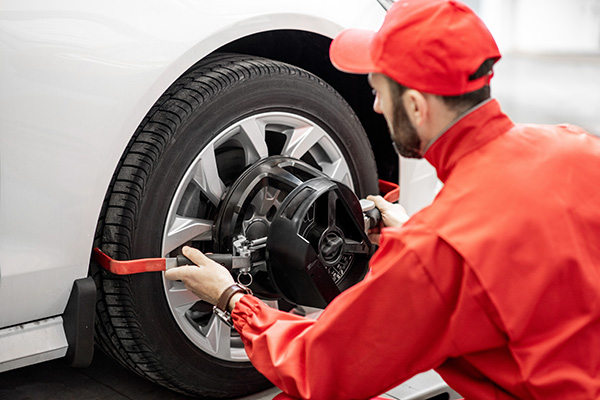
Wheel alignment and tire balance sound similar, but they solve very different problems. One sets the angles your wheels point and lean, which determines how the car tracks and how the tires wear. The other evens out the weight around each tire and wheel assembly so it spins smoothly at speed.
Knowing which service you need saves time and money.
Alignment vs. Balance in Plain Terms
Alignment adjusts the chassis geometry so the wheels point in the correct direction and sit at the correct tilt. Balance adds or moves small weights so each tire and wheel spins without a hop or shake. Alignment changes how the car drives and how the tires wear over thousands of miles. Balance changes how smooth it feels today on the freeway.
Symptoms You Can Feel From the Driver’s Seat
Use these quick cues to narrow it down:
Likely Alignment
The steering wheel sits off center on a straight road, the car drifts left or right, you see feathered edges or one shoulder wearing faster, light tramlining on rutted pavement.
Likely Balance
A shake in the steering wheel between 55 and 70 mph that fades above or below that range, a buzz in the seat or floor at freeway speeds, a vibration that returned after rotating tires.
Could Be Both
A rim or tire that took a hard hit, a recent curb strike, or new tires installed without a post-install alignment.
What Alignment Actually Adjusts
On most vehicles, alignment sets three angles:
- Toe controls whether the fronts of the tires point slightly in or out. Too much toe scrubs tread quickly and can reduce fuel economy.
- Camber is the inward or outward tilt when viewed from the front. Incorrect camber wears one shoulder and can hurt braking grip in the wet.
- Caster is the forward or rearward tilt of the steering axis. Correct caster helps the wheel return to center and adds high-speed stability.
Our technicians measure all four corners on a calibrated rack, compare the readings to factory specs, and adjust what the suspension allows. If a bent component or worn bushing sits outside the spec window, we note it so you know why settings will not hold.
What Balancing Actually Fixes
No tire and wheel is perfectly uniform. When the heavy spot is not cancelled by a weight on the opposite side, the assembly wants to hop or shimmy as speed rises. Spin balancing locates that heavy spot and places small clip-on or adhesive weights to neutralize it.
Road-force balancing goes further by applying a roller load to simulate the road, then matching the tire’s stiff spot to the wheel’s low spot for the smoothest result.
When to Choose One, the Other, or Both
If the steering wheel is crooked or the car will not track straight on a flat road, schedule an alignment first. If the car is straight but shimmies at a specific speed, start with a balance. After installing new tires, do both: balance immediately, then align to protect the new tread from early edge wear.
After a pothole or curb impact, we often need to balance and then check alignment, since the hit can shift weights and nudge the toe out of spec at the same time.
After-Service Expectations and Road Test
After a proper alignment, the wheel should sit level on a straight, uncrowned road, the drift should be gone, and the tires should wear evenly over the next several thousand miles. After a correct balance, the steering wheel and seat should feel calm at the speeds that used to buzz.
If a shake remains, it may be a bent wheel, a separated tire belt, or a worn suspension or brake part that balance cannot solve. We road test each vehicle to confirm the results and share the printouts so you can see the numbers behind the feel.
Habits That Keep Things in Spec
- Maintain correct tire pressures when cold. Low pressure increases heat and shoulder wear that mimics misalignment.
- Rotate on schedule to even out front and rear wear patterns.
- Recheck alignment after suspension work, a curb hit, or when you notice new feathering.
- Keep wheels clean inside and out. Packed mud or caked brake dust can throw balance off by an ounce or more.
Get Wheel Alignment and Tire Balancing in San Diego, CA with Import Auto Specialists
Want a car that tracks straight and feels smooth on the freeway? Visit Import Auto Specialists in San Diego, CA. We measure all four corners on a calibrated alignment rack, balance with precise equipment, and road test to confirm the fix so your tires wear evenly and the steering stays calm.
Schedule an appointment today and bring back that easy, quiet highway feel.